
The True ROI of Video Documentation: Why Traffic Management Companies Don't Need a Mandate to Benefit
Most conversations about video documentation in traffic management (the practice of capturing structured video footage of roadwork site setups, crew activity, and sign placement) start with compliance: regulatory obligations, what happens when something goes wrong, what an auditor will look for. Those conversations matter. But they miss the more immediate financial case.
The return on investment (ROI) from video documentation doesn't begin when a regulator requires it. For many Australian traffic management businesses, it starts on day one in how their teams operate, the costs they quietly carry, and the capacity they can unlock without adding headcount.
This post breaks down where that ROI actually comes from, starting with one of the clearest and most underestimated examples: site audits.
How Does Video Documentation Reduce Traffic Management Site Audit Costs?
Video documentation reduces site audit costs by eliminating the need for compliance officers to physically travel to every site.
When crews capture structured footage at setup, supervisors can review that footage remotely - from the office, or anywhere - in a fraction of the time a site visit would take.
Ask most traffic management business owners how their site audits work, and you'll hear a consistent answer: a supervisor or compliance officer drives out, checks the setup against the Traffic Management Plan (TMP) and Traffic Guidance Scheme (TGS), then drives back. Across a business running ten to fifteen active sites, common for a mid-sized contractor in New South Wales, that's a significant amount of time and money absorbed by travel that rarely appears as a line item on anyone's budget.
The costs are real, even when they're invisible. A round trip to a site an hour away costs fuel, vehicle running costs, and two or more hours of a senior person's time. For someone spending two or three days a week on site visits, the annual cost easily runs to tens of thousands of dollars in lost productivity and direct expenses — before a single compliance issue has been identified.
Video documentation changes this equation entirely. A supervisor reviewing a site setup video can cover five sites in the time it would previously take to visit one. The coverage scales. The cost doesn't.

What Are the Productivity Benefits of Remote Site Audits?
Remote site audits via video allow compliance officers to review three to four times more sites in the same working week, without additional travel cost.
For a business with a compliance officer currently visiting four sites per week, each requiring an average of two hours of travel, switching to remote video review can free up eight or more hours of productive capacity weekly. That's equivalent to a full working day, every week, redirected from windscreen time to higher-value activity.
Beyond volume, video review is often more thorough than a physical visit. A supervisor on a live site can observe a moment in time. A reviewer watching structured site footage can pause, rewind, zoom in on specific signage, and review the setup at multiple points during a shift. Issues that might be missed in a five-minute walkthrough become visible when you can scrub through footage methodically.
The coverage improvement also has a direct compliance benefit. Sites that previously weren't being audited because the travel wasn't practical can now receive a remote review. For clients who ask how you monitor your crews, that's a meaningful and demonstrable answer.
How Much Can a Traffic Management Business Save with Video Documentation?
The savings depend on site volume and geography, but a traffic management contractor doing four site visits per week can typically recover more than $20,000 annually in reduced travel and compliance officer time.
The framework is straightforward:
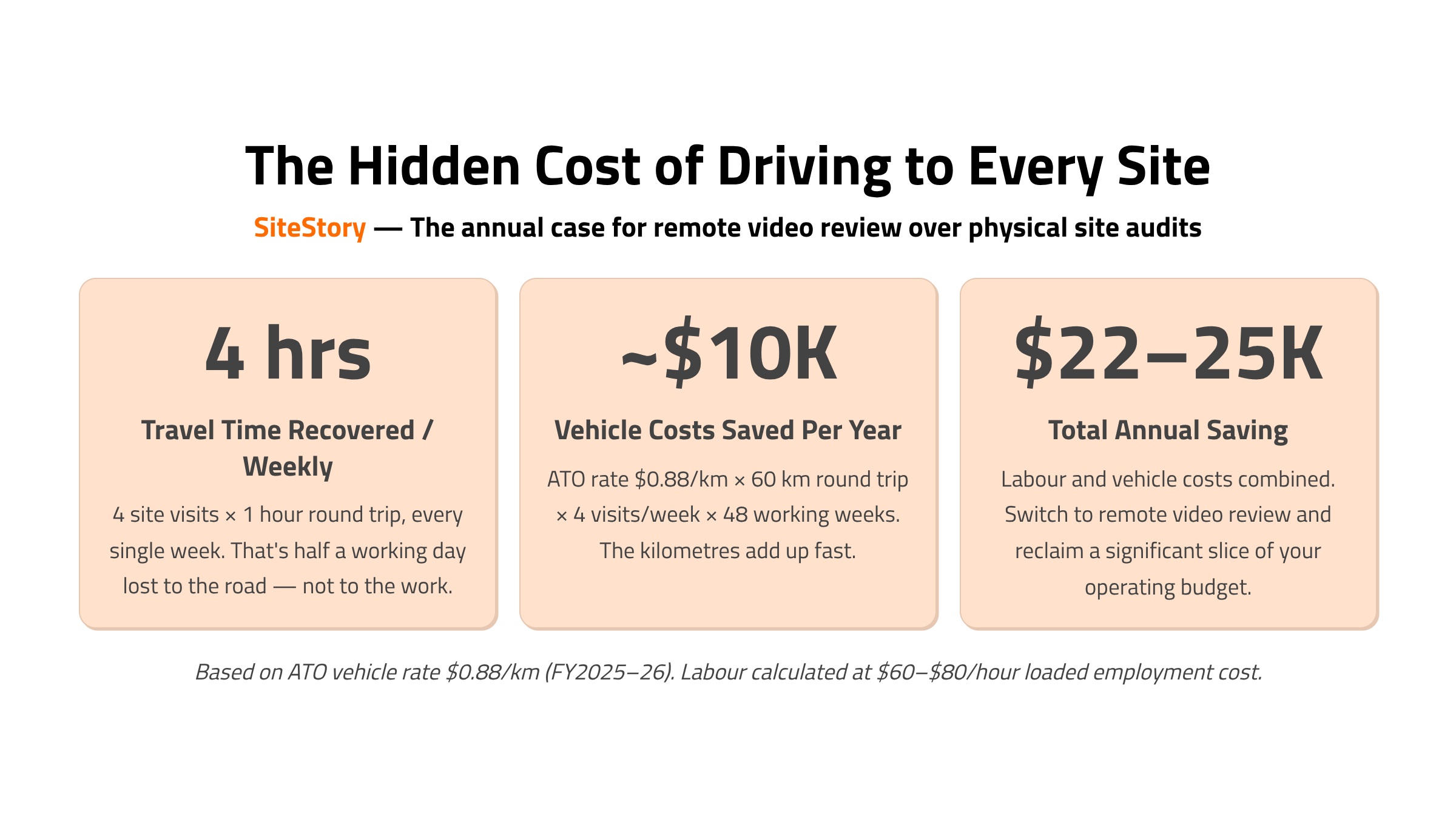
Travel time recovered: 4 visits × 1 hour round trip = 4 hours/week. At a fully loaded employment cost of $60–$80/hour for a senior compliance officer, that's $240–$320 in labour cost per week, or roughly $12,000–$15,000 per year.
Direct vehicle costs: At the ATO's standard vehicle rate of $0.88 per kilometre (FY2025–26), a 60km round trip four times per week adds up to approximately $10,000 per year in vehicle costs alone.
Combined potential saving: $22,000–$25,000 per year for a business doing four site visits per week — and that's before accounting for the additional sites that remote review makes possible.
Those savings don't require any change in compliance standard. They come from doing the same audit work differently — and they're available to any business willing to embed video documentation into how their crews operate.
What Are the Other ROI Benefits of Video Documentation for Traffic Management?
Remote auditing is the clearest source of immediate return, but it's not the only one. Traffic management businesses working with video documentation typically report benefits across four additional areas.
Faster dispute resolution. When a complaint is raised - by a member of the public, a client, or a regulator - the response with video documentation is measured in minutes. You retrieve the footage, you have your answer. Without it, resolution depends on crew recollection and paper records, which is slower and less credible. For a business managing multiple active sites, disputes are an operational cost; video documentation compresses that cost significantly.
Reduced rework and callbacks. When supervisors can review setup footage before a shift is complete, issues are caught while the crew is still on site. A crew that gets a correction call before packing up costs far less to remediate than one that has to return the following morning. In traffic management, where mobilisation costs are high, this is a meaningful saving.
Faster crew onboarding and training. A library of site footage is a training resource that compounds in value over time. New crew members can review examples of correctly configured sites with properly placed signs, appropriate delineation, and correct TMP/TGS implementation before they step on a live site. This accelerates onboarding and reduces the supervision burden on experienced team members.
Stronger position in insurance and liability situations. When a traffic management contractor can produce structured, timestamped video evidence of a correctly configured site, it materially changes a liability or insurance conversation. Whether it's an insurer assessing a claim or a legal team reviewing an incident, video evidence compresses the resolution process and strengthens the contractor's position.
Do You Need to Be Required to Use Video Documentation to See the ROI?
No. The financial case for video documentation in traffic management exists independent of any regulatory mandate. While road authorities in some Australian states are moving towards requiring more robust site documentation, the businesses currently seeing the strongest ROI adopted the practice before they were asked to.
The reason is straightforward: the operational benefits - reduced audit travel, scaled compliance coverage, faster dispute resolution, lower rework costs are present from the first week of use. They don't depend on a compliance deadline or a client requirement. They depend on whether your crews are capturing footage and whether your supervisors are reviewing it.
For contractors working across multiple sites in New South Wales, Victoria, or Queensland, the case is particularly strong. Geographic spread makes travel-heavy audit processes expensive and limits coverage. Video documentation solves both problems simultaneously.
The businesses that will be best positioned in two or three years - both operationally and in their client relationships - are those that have already built a documentation habit, have a library of site records demonstrating consistent practice, and can show clients and auditors a mature process rather than a rushed implementation.
Frequently Asked Questions
What is video documentation in traffic management? Video documentation in traffic management refers to the practice of capturing structured video footage of roadwork sites - including setup, sign placement, crew activity, and pack-up - to create a verifiable record of compliance with a Traffic Management Plan (TMP) and Traffic Guidance Scheme (TGS). It is used as evidence in audits, disputes, and insurance claims, and increasingly as a tool for remote site management.
Is video documentation required by law in Australia? Requirements vary by state and client. Some road authorities and principal contractors in Australia are beginning to require video or photographic evidence of site setups, but there is currently no universal mandate. However, many traffic management contractors are adopting video documentation voluntarily because of the operational and financial benefits it provides, independent of compliance requirements.
Can video documentation replace physical site audits? Video documentation can replace the majority of routine physical site audits - particularly setup checks and compliance reviews against TMP and TGS requirements. Physical visits remain valuable for complex sites, incidents, and situations where on-the-ground assessment is needed. Most businesses use a hybrid approach: remote video review for routine audits, physical visits for priority situations.
How does video documentation reduce costs for traffic management businesses? The primary cost reduction comes from replacing travel-heavy physical site audits with remote video review. A compliance officer who previously spent an hour travelling to and from each site visit can review multiple sites remotely in the same time. This reduces fuel costs, vehicle wear, and lost productive time - with typical savings running to $22,000–$25,000 annually for a business doing four site visits per week, based on the ATO's FY2025–26 vehicle rate of $0.88 per kilometre.
What is a Traffic Management Plan (TMP)? A Traffic Management Plan (TMP) is a formal document required for roadwork sites in Australia that outlines how traffic - including vehicles, cyclists, and pedestrians - will be managed safely during works. It is prepared before works begin and must be implemented correctly on site. A Traffic Guidance Scheme (TGS) is the specific layout of signs, devices, and lane configurations that implements the TMP on the ground.
What is SiteStory? SiteStory is a mobile-first video documentation platform built specifically for traffic management contractors in Australia. It enables site crews to capture structured video evidence at setup and throughout the working day, and allows supervisors to review that footage remotely - reducing the need for physical site visits and creating a complete, timestamped record of site compliance.
SiteStory is built by practitioners who understand traffic management compliance on Australian roads. Our platform is used by contractors across Australia and beyond to capture, store, and review site documentation, so teams can work with confidence and supervisors can audit from anywhere.
