
Go Back
Introducing Site Video Logs (SVL): The Next Evolution in Traffic Management Compliance
A Site Video Log (SVL) is a structured method of capturing, verifying, and storing video-based evidence of site conditions, activities, and compliance throughout the lifecycle of a road, civil, or infrastructure project.


A Site Video Log (SVL) is a structured method of capturing, verifying, and storing video-based evidence of site conditions, activities, and compliance throughout the lifecycle of a road, civil, or infrastructure project. Unlike traditional documentation methods such as written reports, photos, or checklists, SVL provides timestamped and geolocated video documentation that offers an auditable record of on-site activities before, during, and after work completion. SVL integrates with job management systems, stores videos securely for 7+ years, and provides immediately searchable and shareable evidence for compliance verification.
The Documentation Question Every Traffic Management Company Faces
Your crew just finished setting up a complex traffic management scheme on a major arterial road. Three months later, a question arrives: "Can you prove your setup was compliant?"
You open your documentation files. What do you have?
Photos: Fifteen plus individual images from different moments. Some taken before final adjustments. No clear narrative connecting them.
A checklist: You ticked "yes" next to each requirement. But ticks don't show spatial relationships or capture site conditions.
A written report: You described the setup. But descriptions are interpretations, subject to memory.
None of these options tell a complete, verifiable story.
This is why the traffic management industry is evolving toward a different documentation standard, one that provides comprehensive, verifiable evidence without the time burden of traditional methods.
We call it the Site Video Log.
What is a Site Video Log (SVL)?
Formal Definition:
Site Video Log (SVL) is a structured method of capturing, verifying, and storing video-based evidence of site conditions, activities, and compliance throughout the lifecycle of a road, civil, or infrastructure project.
Unlike scattered photos or manual checklists, an SVL provides:
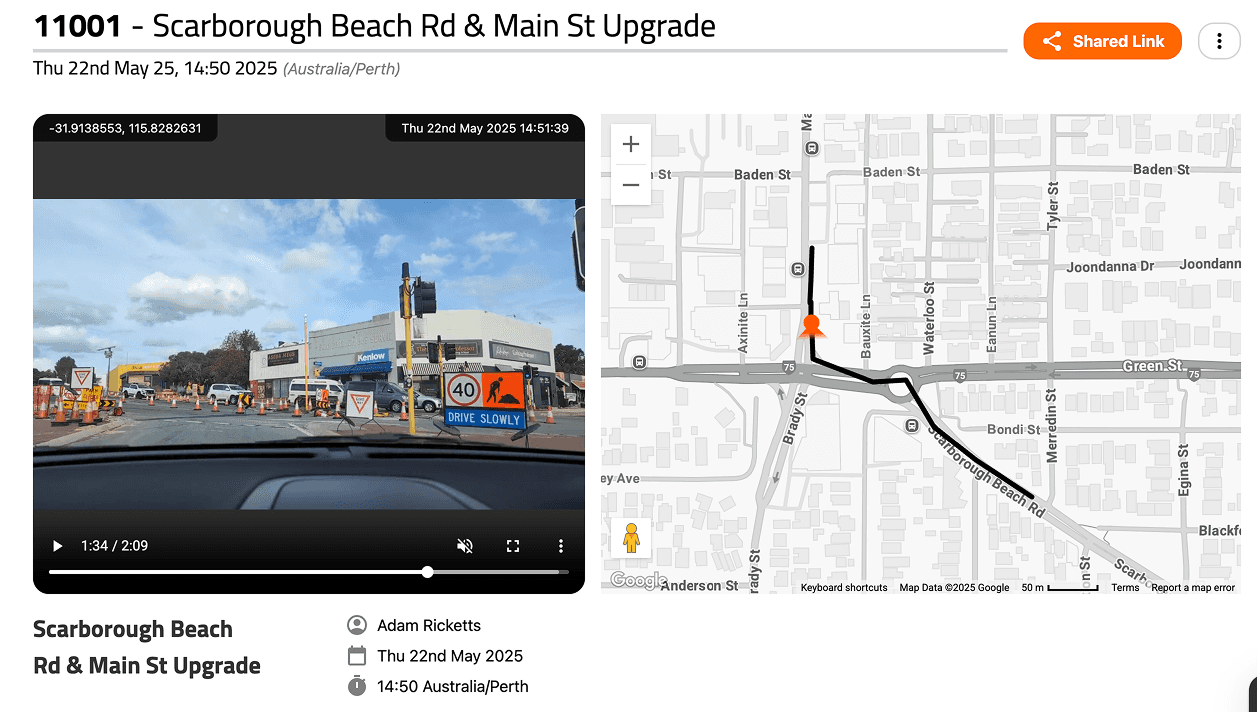
✓ Continuous visual documentation - Sequential records showing complete site setup flow, not snapshots
✓ Embedded verification data - Every video includes timestamp and GPS location data, ensuring authenticity
✓ Structured organisation - Videos link directly to specific job bookings in your management systems
✓ Long-term accessibility - Secure cloud storage for 7+ years (included in subscription)
✓ Immediate retrievability - Searchable by job number, date, location, or crew member, find what you need in seconds
✓ Instant shareability - Generate links to share complete site evidence without compiling files
The Five Key Principles of Site Video Logs
For video documentation to qualify as a proper Site Video Log, it must adhere to five core principles:
1. Accuracy and Integrity
The Principle: Video records must include time, date, and location data to ensure authenticity.
An SVL embeds verification data directly into the video file:
Timestamp: Exact date and time of recording
GPS coordinates: Precise location where video was captured
Device metadata: Recording device and software information
This embedded data transforms video from "here's what we say happened" to "here's verifiable proof of what happened, when, and where."
Real-World Application: When a traffic incident occurs near your work zone and investigators question compliance, an SVL provides timestamped evidence showing exactly what your setup looked like at that specific time. No reconstruction needed.
2. Accessibility and Retention
The Principle: Records should be securely retained and retrievable for 7+ years to meet legal, contractual, and risk management requirements.
Traditional photo documentation challenges:
Storage on individual devices that disappear when crew members leave
Scattered across multiple systems with no guaranteed retention
File corruption and data loss over time
An SVL approach provides:
Centralised cloud storage included in subscription
Redundant backups ensuring against data loss
Systematic retention with automated 7+ year policies
Audit trails recording access history
Secure access controls for authorised personnel only
Real-World Application: Seven years after completing a major project, a contractual dispute arises. With traditional photos, you're searching archived bookings, hoping files still exist. With SVL, you search by project and date; videos are still intact, verifiable, and conclusive, all included in your subscription service.
3. Usability
The Principle: Video data should be easily reviewable, searchable, and exportable for compliance checks, audits, and investigations.
Traditional challenges: scrolling through hundreds of photo thumbnails, ambiguous file names, multiple repositories, no contextual search.
An SVL system provides:
Advanced Search:
By job number, project name, date range
By GPS location or address
By crew member, client, or project
Custom tags and categories
Quick Review:
Video thumbnails and variable playback speeds
Screenshot extraction for reports
Notes and annotations
Export Options:
Shareable links
Download original files with metadata
Client/auditor access creation
Real-World Application: Client requests verification of three sites from last month. Search by client and date, find videos in 2 minutes, generate shareable links, send in under 5 minutes total. Client reviews complete setups, not fragmented photos.
4. Privacy and Governance
The Principle: Video documentation must comply with privacy, surveillance, and workplace laws.
Video captures workers, license plates, private property, and members of the public, creating obligations under Australian privacy laws, workplace surveillance regulations, and WHS requirements.
An SVL approach addresses:
Privacy Protections:
Clear policies on what gets recorded and why
Workforce notification requirements
Data handling protecting personal information
Retention limitations (delete after 7 years unless legal holds apply)
Access Controls:
Role-based permissions
Audit trails showing who accessed videos
Secure authentication
Client and project-specific restrictions
Data Security:
Encryption during transmission and storage
Australian-based data centres for sovereignty compliance
Secure deletion protocols
Regular security audits
Real-World Application: Your SVL implementation includes notifying workers about documentation purposes, establishing role-based access (crew sees their sites, supervisors see teams, management sees all), storing data in Australian centres, and ensuring videos are used only for compliance, safety, and business purposes.
5. Integration with Digital Systems
The Principle: SVL records should integrate with job management, safety, and project management systems for unified activity records.
Traditional Documentation Friction: Create job booking → Complete work → Take photos → Open job system on phone → Find booking → Manually upload → Manually attach → Add notes → Hope it synced
Each manual step creates opportunities for forgotten documentation, wrong attachments, incomplete uploads, and administrative burden.
The SVL Integration Approach:
Job bookings automatically sync to SVL app → Crews see scheduled sites already listed → Record video, it auto-links to correct booking → Videos appear in job management system → Zero manual administration
Integration Benefits:
For Field Crews: Zero extra steps beyond pressing record, no confusion about where documentation goes
For Office Staff: All documentation in familiar systems, complete job records in one place
For Clients: Access through existing project portals, real-time visibility
Real-World Application: Traffio scheduler creates 12 job bookings at 8 AM. All 12 automatically appear in SiteStory. Crews record videos throughout the day. Videos auto-upload and link to correct bookings. By 4 PM, operations manager sees all 12 sites have complete video documentation in Traffio. Zero manual administration.

Why SVL Is Becoming the Industry Standard
1. Major Contractors Are Raising Requirements
Tier 1 contractors increasingly specify video documentation in contracts because it provides superior compliance verification, reduces their liability, enables faster verification, allows remote quality assurance, and differentiates professional contractors.
What this means: If you're tendering for work with major contractors, video capability is increasingly expected. Companies offering only photos may face competitive disadvantage.
2. Government Clients Recognise Superior Evidence Quality
State transport departments and councils acknowledge video provides more reliable compliance evidence. Some government projects will start to explicitly request video documentation. Regulatory audits increasingly reference video evidence. Incident investigations treat video as higher-quality evidence.
What contractors experience: "We supply links to our Site Video Logs when government clients request verification. Their feedback has been consistently positive; they can see exactly what our setup looked like, which makes their auditing much easier."
3. Industry Leaders Are Establishing It as Standard Practice
Forward-thinking traffic management companies are adopting SVL proactively for competitive differentiation, risk reduction, operational efficiency, client confidence, and workforce safety.
The adoption curve:
Early Adopters (2025-2026): Willing to try new approaches
Early Majority (2026-2027): Implementing with proven best practices ← We are here
Late Majority (2027-2028): Adopting because it's becoming expected
Laggards (2029+): Forced to adopt by client requirements
4. The Evidence Quality Gap Is Undeniable
Complex Freeway Closure Setup:
Photo Documentation: 21 separate images requiring mental reconstruction
Site Video Log: 10-minute video showing complete sequential setup with all signage in context, GPS data, timestamp, 1 comprehensive record requiring no reconstruction
This evidence quality gap is why clients prefer video, regulators trust it more, disputes resolve faster, and insurance providers value it.
How SVL Differs from "Just Recording Video"
Occasional Video Recording:
❌ Captured inconsistently
❌ Stored on individual phones or SD cards with no backup
❌ Not linked to job bookings
❌ Difficult to find later
❌ No retention policy
❌ No system integration
❌ No standardised approach
Site Video Log System:
✅ Captured systematically for all sites
✅ Auto-uploaded to secure cloud (included in subscription)
✅ Linked to job bookings automatically
✅ Searchable by multiple criteria
✅ 7+ year retention guaranteed
✅ Integrated with job management platforms
✅ Consistent methodology across organisation
The analogy: Occasional videos are like keeping receipts in your glove box. SVL is like using proper accounting software. Every transaction is recorded, categorised, searchable, and retained systematically.

The Practical Benefits Contractors Are Experiencing
Benefit 1: Client Verification in 90 Seconds (vs 20 Minutes)
Open job system → Find booking → Generate shareable link → Send to client. Client receives link, views complete timestamped/geolocated site setup, gets all questions answered in one record.
Impact: Stronger client relationships through responsive, transparent communication
Benefit 2: Dispute Resolution in Hours (vs Weeks)
Without SVL: Gather fragmented photos, interview crew, reconstruct timeline, write explanations, multiple clarifying rounds. Timeline: Days to weeks.
With SVL: Pull up video, send link, video shows exactly what happened. Timeline: Hours to 1-2 days.
Impact: Reduced legal exposure, faster resolution, clear protection
Benefit 3: Remote Site Verification
Managers can verify 10+ sites per day remotely, identify issues immediately while crews are still on-site, and provide specific feedback referencing video.
Impact: Higher quality setups, reduced non-conformance, scalable oversight
Benefit 4: Training Resources
Real site videos from actual projects provide a variety of site types, examples of excellent setups, and preparation for new hires before working independently.
Impact: Faster onboarding, higher quality work, reduced mistakes
Benefit 5: Competitive Advantage
Several customers report winning work specifically because clients valued their video documentation approach. One contractor: "The client mentioned our SiteStory capability in their feedback. That tender was worth $2M+ to us."
Impact: Higher win rates, access to premium contracts
Industry Standardisation and Engagement
We're working with industry bodies and leaders to establish SVL as a recognised standard for traffic management documentation.
Current engagement:
Austroads
We've shared the SVL definition paper with Austroads, the association of Australasian road transport and traffic agencies. Their recognition and potential endorsement would establish SVL as an industry-wide standard across Australia and New Zealand.
Traffic Management Association of Australia (TMAA)
We're actively engaging with TMAA, the national industry membership body representing traffic management professionals across Australia, to consult on including Site Video Logs in future revisions of their National Traffic Management Safety Guidelines.
TMAA's guidelines are widely recognised as industry best practice and are used by traffic management companies, contractors, and government agencies to establish safety and compliance standards. Inclusion of SVL principles in these guidelines would:
Formalise video documentation standards across the Australian traffic management industry
Provide clear guidance for contractors on implementing structured video evidence systems
Support procurement requirements as clients reference TMAA guidelines in contracts
Advance industry safety outcomes through improved documentation and verification practices
Create consistent expectations for what constitutes professional-grade site documentation
This consultation process reflects TMAA's commitment to evolving industry standards to match technological capabilities and client expectations. As video documentation becomes more prevalent, having structured guidelines ensures all contractors can implement it effectively and consistently.
Early Adopter Feedback
Traffic management contractors implementing SVL are providing feedback that refines best practices and implementation approaches, contributing to the development of industry-wide standards.
Client Validation
Major contractors and government clients requesting video documentation are validating the need for structured approaches rather than ad-hoc video recording.
Why standardisation matters:
When SVL becomes a recognised standard through bodies like Austroads and TMAA:
Common language: Clients can specify "SVL-compliant documentation" in contracts
Quality benchmarks: Clear criteria for what constitutes proper video documentation
Professional credibility: SVL recognised as professional practice, not experimental approach
Industry advancement: Raises the bar for all traffic management documentation
Safety outcomes: Improved documentation supports better site safety and compliance
The definition paper we've shared outlines:
What constitutes an SVL (vs casual video recording)
The five key principles SVL must meet
Purpose and application in traffic management
Industry benefits from SVL adoption
Privacy and governance considerations
This standardisation work positions Site Video Logs as the next chapter in traffic management compliance, not just a technology, but a methodology recognised by leading industry bodies.
Common Questions About SVL
Q: Do we still need photos with SVL?
Most contractors eliminate individual sign photography entirely. A site video shows everything 10-15 photos would, plus more. Some retain photos only for extreme closeups or before/after comparisons, but video replaces photos for standard site documentation.
Q: What about poor mobile coverage?
Videos store locally and upload automatically when connectivity is restored. You don't need reception at the site, videos upload when returning to coverage areas.
Q: How do we ensure crews actually record SVLs?
Key strategies: Strategic pilot approach (not "big bang"), integration with job management systems, client engagement creating external demand, recognition and metrics, proper equipment provision. Contractors consistently achieve 90%+ adoption within 3 months.
Q: What's the subscription cost?
SVL platforms typically operate on tiered models starting around $100 per month, scaling based on monthly video volume. Subscription includes: secure cloud storage, 7+ year retention, job management integration, unlimited access/sharing, updates, and support. Contractors completing 1,000 sites annually save 200+ hours on documentation, these time savings alone justify the subscription cost 5-10x over.
Q: Will clients accept video instead of photos?
In 95%+ of cases, clients prefer video once they see it. Video provides more comprehensive evidence. The few exceptions usually come from unfamiliarity (resolved by showing them) or specific compliance systems (screenshots from video work). Consistent feedback: clients love video and often request it going forward.
Q: How long does implementation take?
Using strategic pilot approach: Week 1 (planning), Week 2 (launch pilot), Weeks 3-4 (build momentum), Weeks 5-8 (first expansion), Months 3-4 (broader rollout), Month 4+ (90%+ adoption as standard). Key is starting narrow, proving value quickly, expanding from success.
What This Means for Your Operation
1. Where are you on the evolution curve?
Checklists → Photo documentation → Ad-hoc videos → Structured Site Video Logs
Most contractors are between photos and ad-hoc videos. Will you formalise an SVL approach now or wait until clients require it?
2. What's the opportunity cost of delayed adoption?
Every month with photo documentation instead of SVL means:
40-45 hours lost to documentation overhead (1,000+ sites per year)
Client requests taking 20 minutes instead of 90 seconds
Quality issues not caught via remote verification
Missed tender opportunities
Continued reliance on fragmented evidence
The cost isn't just the subscription, it's the efficiency, quality, and competitive position you're not gaining.
3. Lead or follow this evolution?
We're currently in the transition from early adopters to early majority. Companies implementing SVL now gain first-mover advantages: client recognition, tender differentiation, operational learning curves.
In 2-3 years, video documentation will likely be standard expectation. Will you have 2-3 years of experience by then, or be implementing because you have to?
The Future of Traffic Management Documentation
More post you may like

Video Documentation
Thought leadership
Video Evidence for Disputes: What You Can Prove
20 Sept 2026
·
Adam Ricketts

Thought leadership
Video Documentation
Construction Compliance Documents for Fast-Changing Sites
16 July 2026
·
Adam Ricketts

Industry Insights
Video Documentation
Regulatory Compliance in Construction: A Crew Documentation Guide
8 July 2026
·
Adam Ricketts

Industry Insights
Video Documentation
Reduce Rework in Construction: Blame the Gap, Not the Crew
1 July 2026
·
Adam Ricketts

The purpose-built video documentation platform for traffic management and construction. One tap. Organised automatically. Ready when you need it most.


